After last week’s existential crisis, I felt it was time to build (myself) back better (is it too soon for that pun?!). In the literal sense, that is. Assembling furniture was involved. But before I get into all of that, I’d like to start this post with my visit to contemporary art exhibition ‘My World’ at museum Singer Laren (in Dutch). My visit proved to be a first inspirational step in my week of building back better!
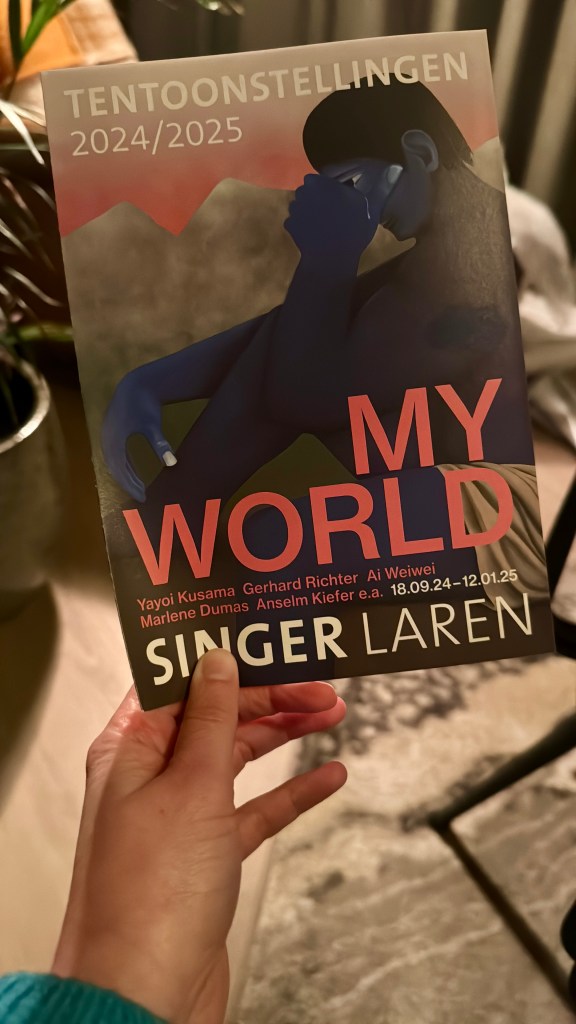
My world is our world
Given the title of the exhibition, you’d be forgiven for thinking that this was just another hoity toity, navel-gazing art exhibition, all wrapped up in the pretty box that is museum Singer Laren. Nothing can be further from the truth. Guest curator Hans den Hartog Jager manages to create a deceptively simple but meaningful journey showcasing many famous and not so famous contemporary works of art, all from private collections. Actually, I think ‘My world’ is more about our world. Not in the Disneyfied-it’s-a-small-world-after-all kind of way. This exhibition is a colourful, hopeful yet real display of paintings, installations, and sculptures. Each work packs a punch as a stand-alone piece. As a whole, the exhibition definitely was my ticket out of last week’s wallowing stupor.
The exhibition itself consists of seven rooms, each dedicated to a specific theme. Big gun contemporary artists (Ai Weiwei, Yayoi Kusama, Anselm Kiefer, etc.) happily share spaces with lesser-known (at least to an amateur art lover like myself) artists. Walking through the seven rooms is a journey like no other, yet at the same time, it is a strangely familiar one:
1. human (an ode to the personal, the self)
2. abstraction (going back to basics, building blocks, concepts)
3. nature (introducing more recognisable elements like, well, nature)
4. inside (presenting the interior, the home, objects around the house)
5. outside (a careful glimpse into to the outside world)
6. the big world (eyes wide open to the harsh, almost apocalyptic realities of the wider world)
7. heaven and the universe (a nudge back into reflection and perspective-taking)
What an epic journey! Unfortunately, the online audio tour is only available in Dutch, but, at least until the end of the exhibition (12th of January 2025), you will be able to scroll through the works of art on display (just click on ‘Objecten’). Obviously, it’s no substitute for experiencing the actual exhibition, but I realise Laren isn’t on everybody’s bucket list of worldly travel destinations…
From IKEA art to IKEA furniture
Bear with me as I cunningly weave this first part of my blog post into the final part of my building-back-better week. In the second exhibition room called ‘abstraction’, there stands a tower of IKEA coffee tables, which is a work by Ryan Gander called Samson’s Push or No VI/Composition No.II (2011). I love how the artist has given his work two titles for the price of one; for those familiar with the bible (not me, much to the disappointment of my grandma), he’s called it Samson’s Push. But the second part of the title, which is more up my street, refers to Piet Mondrian’s painting No. VI / Composition No.II (1920). (Obviously, I didn’t know that titbit before reading the description in the accompanying exhibition book.)
Which, by the way, is why I call for (clear!) descriptions and titles in museums. Some people, perhaps well-intentioned or perhaps rather high-mindedly, criticise adding descriptions and titles to museum pieces. They feel people should be free to interpret art by themselves and not to be forced into a certain way of thinking and feeling about the art they see. Be that as it may, I absolutely love titles and (plain-worded!) descriptions. For me they are essential guides/maps into the weird and wonderful, but at times quite daunting, incomprehensible, and snobby, World of Art.
So, in case you missed it, the seamless transition to the second part of this post is good old IKEA. Please recall that this blog is about sensemaking, in art, books, and life. At the same time, it is also about holding myself to account and doing something vaguely productive about my (serious-but-obviously-not-so-serious-in-the-whole-scheme-of-things) addictive book-buying behaviour.
Plastic fantastic
Step one of any behavioural programme addressing addiction, is to acknowledge that you actually have a problem. So, I needed to first unearth all the new books I had hidden away in my wardrobe and bring them into plain sight. Creating extra space by adding more shelves to my living room walls was not an option. But I remembered that I’d seen a cute book trolley in a friend’s’ daughter’s bedroom when I last visited them. Ha! This was an easy, inexpensive way to showcase books and even wheel them around, like they do in libraries (and, I’m hopeful, in the better hospitals and prisons).
So late one night, having just finished my glass of wine and, once again, contemplating the world’s obvious but oblivious demise, I found myself scrolling the web in search of the perfect book trolley. Online shopping 101: NEVER click on the first image Google spouts out. But I did. The photo of the trolley that I clicked looked quite similar to the one I remember seeing in the bedroom of my friend’s daughter. I should have realised when prompted to pay extra for insured delivery (shouldn’t delivery be a given??), that this was not your average semi-secure, semi-above-board web shop.
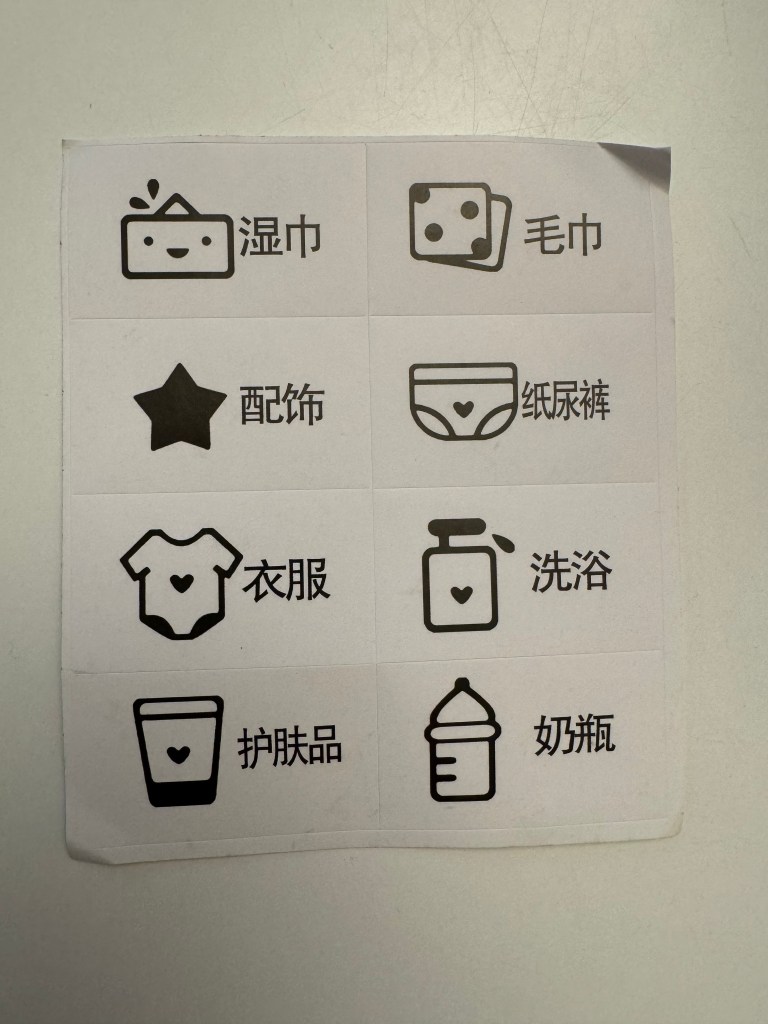
All this happened about three weeks ago. And last week (many weird delivery updates later) I ended up with two very light-weight plastic-bag packages on my doorstep. This can’t be right! I scissored my way through four layers of plastic packaging only to have a fantastic plastic array of flimsy bits and bobs fall out onto my living room floor. Plastic tubing, plastic miniature wheels, not a screw in sight -plastic or otherwise, plastic baskets, one of which was damaged, you get the picture. What on earth? I don’t even think that when stuck together it would hold anything as weighty as books. Ha! The accompanying stickers prove my suspicions.
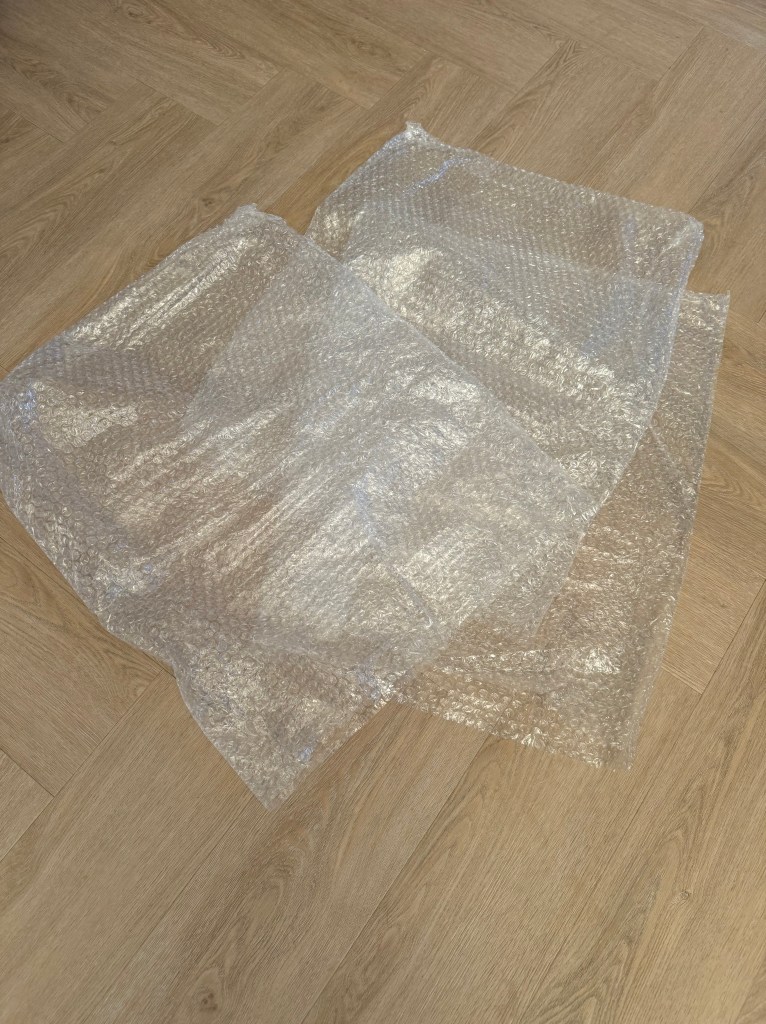
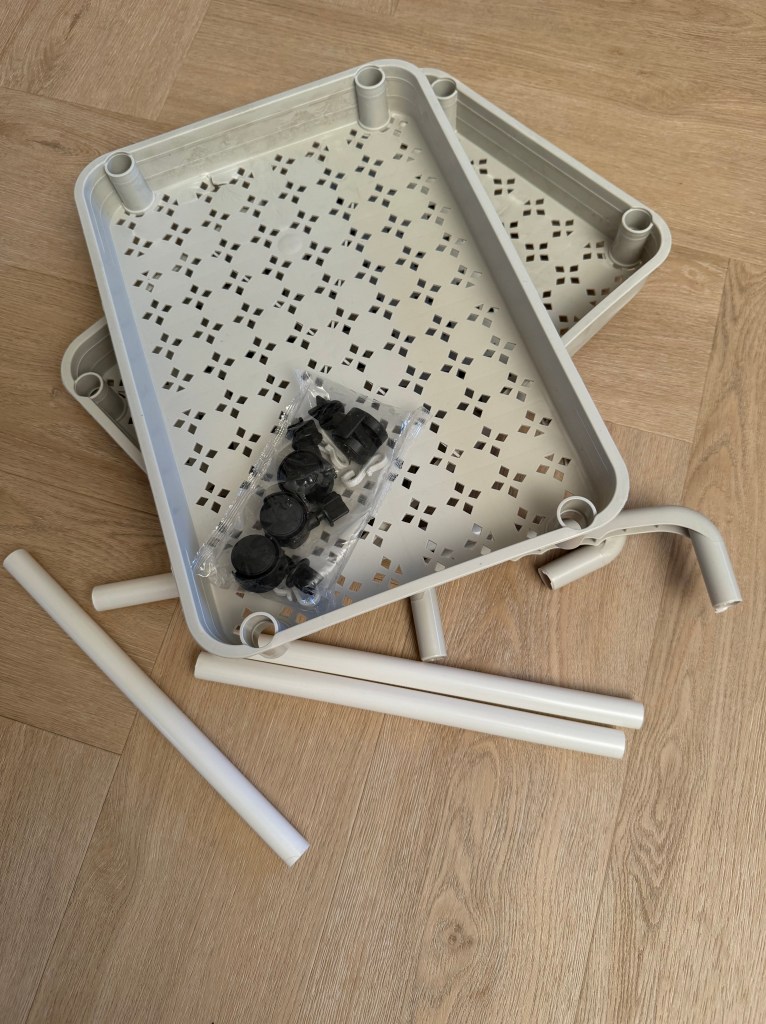
So, what do you do when you’ve obviously been duped but urgently require the trolley anyway? You first alleviate some of your guilt (for buying plastic tat online) by donating a small but well-meant amount to Greenpeace and WWF. After this, you go to the one and only place left in the world that still radiates a bit of truth and hopefulness: IKEA. So, together with my IKEA-groupie friend, I drove to the Swedish beacon of budget design (I don’t dare Google ‘IKEA’ and ‘greenwashing’, just in case it turns out that even IKEA can no longer be considered a safe space).
After some perusing on the app and finding the corresponding ‘address’, I’m finally re-acquainted with the precise trolley I meant to buy all along. Comfortingly heavy boxes full of sturdy metal and an equally comforting 11-page assembling manual; I’m in IKEA heaven. And I’m glad to say that my trolley of shame now stands proudly, if rather smugly (full of unread books), in the middle of my living room next to my television (yet another addiction-enhancing attribute).

Anyway, I’m sure there’s a metaphor-leading-to-an-idiom in this whole trolley-buying business somewhere. Perhaps something linking the plastic-fantastic, cheap and awful trolley, the good-old dependable, design-on-a-budget IKEA trolley with the news of national governments being in constant states of emergency or yet-to-be-formed governments presenting their highly-experienced and well-respected appointees??
To give you a hint: ‘Read reviews and look at facts before you buy into pretty pictures and promises.’ Or: ‘Even if it looks like a trolley and is described as a trolley, it is not necessarily an actual functioning trolley that holds stuff.’ One more: ‘It’s better to go for the familiar, sturdy, if slightly cumbersome and a little boring (although I’m loving the vintage yellow), rather than opting for shiny promises and flimsy fakeness.’
Okay, time to get off my moral high horse. It turns out that both trolleys were made in China anyway. I wonder who’s having the last laugh?!
 Sensemaking.blog