I should have known when I made plans with a friend to attend a lecture the Sunday before last entitled (and freely translated) ‘Before the law: In existential perspective’, that this was an omen for the week to come. I’d been on a steady (if somewhat unhealthy) diet of dystopian novel-reading and series-binge-watching for some time now. Add to that the over-consumption of news, podcasts, and expert analyses, I had successfully numbed myself into freeze mode (although as the fright-flight-freeze coping mechanism goes, I suppose it could also fall neatly into the ‘flight’ category).
So when the lecturer started his talk on Kafka’s ‘The Trial‘, I was very much in my element. What with the state of politics at home and abroad, ongoing wars, apocalyptic climate disasters, and impending world-order changing elections… bring it on Kafka! Full disclosure; I have not read Kafka’s ‘The Trial’. I do remember being quite enamoured with his other book ‘The Metamorphosis‘ as a teenager; imagining somebody change into a giant, beetle-like insect proved quite a vivid image for my pre-smartphone-social-media-addled-teenager-brain.
I refer briefly to the Britannica introduction to this novel (which I perhaps should have consulted before going to the lecture): “The Trial is a novel by visionary German-language writer Franz Kafka, originally published posthumously in 1925. One of Kafka’s major works, and perhaps his most pessimistic, this surreal story of a young man who finds himself caught up in the mindless bureaucracy of the law has become synonymous with the anxieties and sense of alienation of the modern age and with an ordinary person’s struggle against an unreasoning and unreasonable authority. It is often considered to be an imaginative anticipation of totalitarianism.”
Fast-forward to the early morning of the 6th of November. I wake up, hesitate a few minutes before grabbing my phone and … all of a sudden I find myself well and truly metamorphosised into Jozef K.
Wtf happened?
In the following few days I spend my time shutting myself off from the world and immersing myself in my go-to happy place activities. These random activities include watching football on telly, meeting up with friends, eating copious amounts of whatever I have left in my kitchen cupboards, and listening to my carefully-curated Disney song playlist… But as is the inevitable fate of all happy bubbles, in the end, they burst. The realities of the outside world start to seep in. So in honour of this blog, I start grasping for art, books, anything that can help me make some sort of sense of things.
My first point of call is a fantastic retrospective exhibition I went to in Munich in the summer of 2023 by artist Nicole Eisenman. It was an exhibition at Museum Brandhorst and was aptly called ‘Nicole Eisenman. What happened‘. As it states in the press release (I’m paraphrasing) one of the three storylines focuses on US society and the cracks that run through it, and how modern-day tech (such as screens) as well as climate catastrophe influences all our lives. I found Eisenman’s oeuvre of paintings and sculptures to be a colourful, very comical, an appealing, and above all non apologetic critique of (American and Western) modern society.
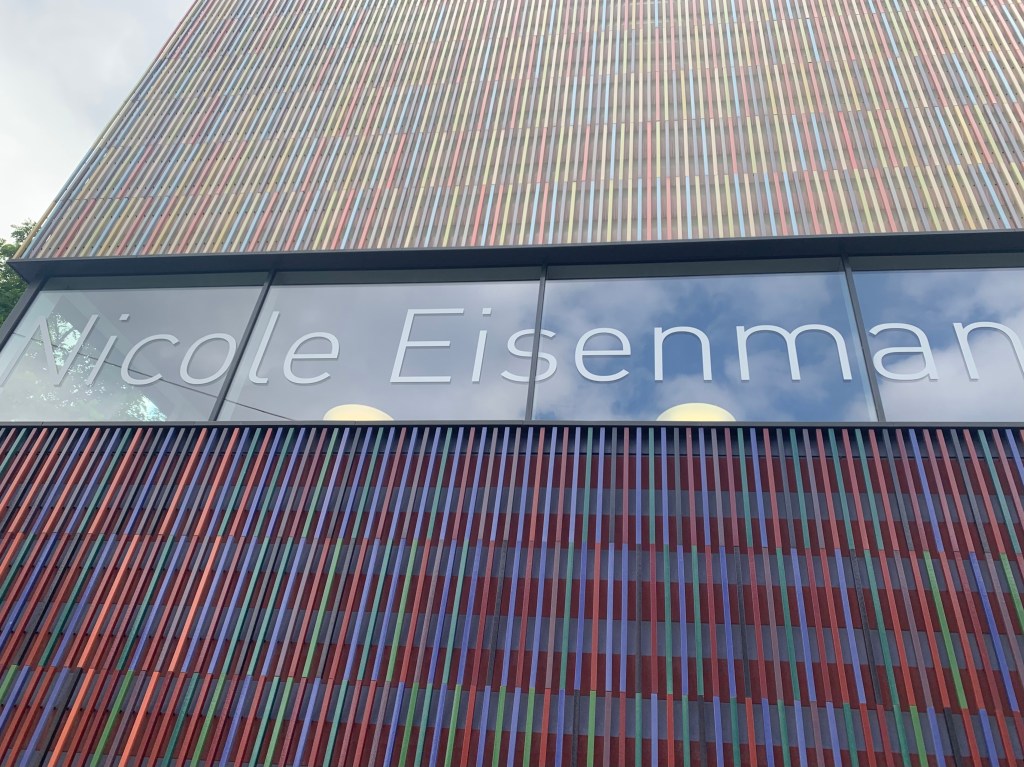
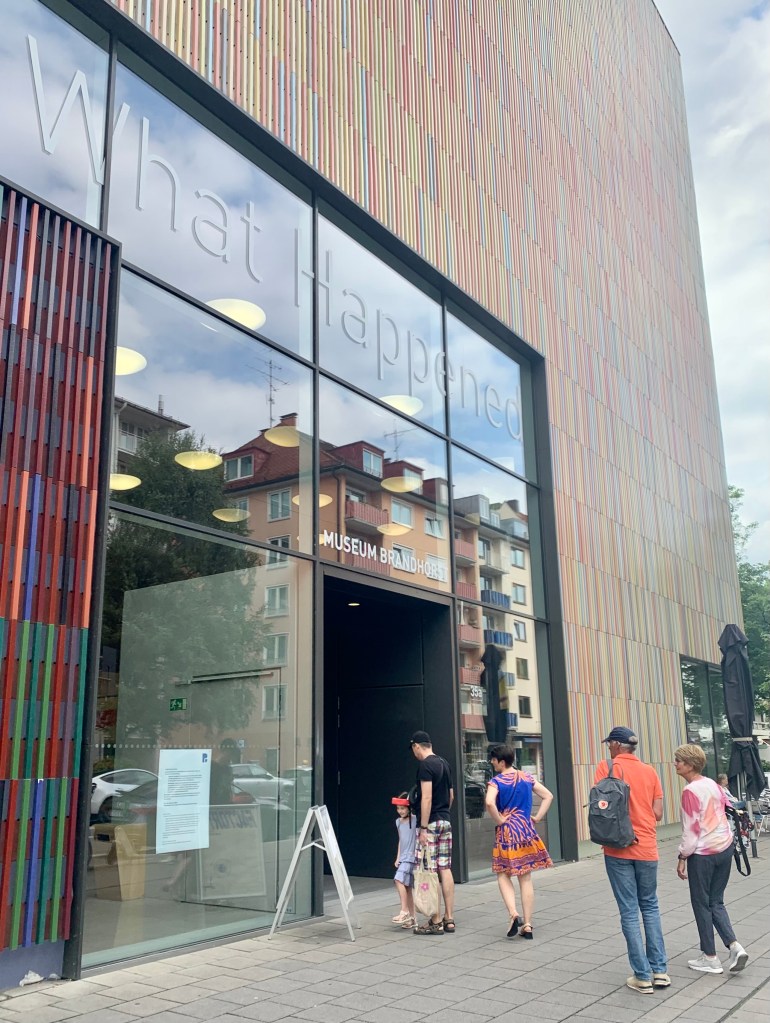
I don’t think I’m allowed to post the photo I took of the backside of one of her larger-than-life figures, which was part of a huge installation with other figures. (I believe it was called ‘Procession’ -in this case I didn’t buy the exhibition book because they had sold out). It won’t show on any photograph, but this figure intermittently farted (a puff of smoke), which made me chuckle, each and every time it happened. Side-step: don’t you agree that farting is a truly post-generational, post-racial, post-political, post-gender, etc., phenomenon; it has the peculiar ability to make even the toughest of crowds wince or at least stifle a giggle.
Moving on. When it comes to books helping to make sense of the world (fiction or non-fiction), there are plenty to choose from, and probably millions more are being written as I write. But the first relevant story that popped into my mind (and is readily applicable to all of the world’s strongmen) is the folktale ‘Pied Piper of Hamelin‘. Officially, it’s a story dating back to late 1600s Germany and has many theories as to its meaning. My recollection as a child was that the Pied Piper wasn’t a very nice man. As an adult, my understanding of the tale is more along the lines of the Pied Piper being a power-hungry nobody who plays a hypnotic tune on his flute, enticing everybody to follow him until they all jump into the overflowing river and drown (literally, I’ve just read that the climate change agenda is off the table). But don’t just believe me; even the Merriam-Webster dictionary agrees with my adult description of the Pied Piper.
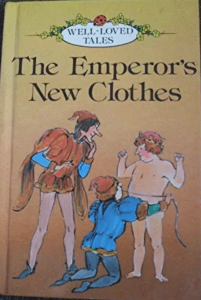
Another children’s tale that comes to mind: Hans Christian Anderson’s ‘The Emperor’s New Clothes‘. Beware: this story is groupthink next level! And I seem to remember the illustrated Emperor on my 1980s copy bears an uncanny resemblance to Mr T himself (be it a much younger version with more hair). And is one of the tailors an Elon Musk in disguise?! I wonder, who (or what) on earth will fulfill the role of the child in the story, the one who finally shouts to the crowd (and jostles them out of their wishful-thinking-daydream state of mind) that the Emperor is actually not wearing anything else but his birthday suit?
What now?
All this reminiscing about my childhood reading habits has led me to think about one of my all-time favourite comic book series: Asterix (and especially the early versions written and illustrated by René Goscinny and Albert Uderzo). Did you know that it’s Asterix’s 65th birthday this year?! Anyway, for the purpose of this post I particularly recommend Asterix and the Roman Agent and Asterix and the Soothsayer (I’ve Googled: e-books are available). But I’m sure there are other Asterix comics that fit the bill.
In any case, each Asterix follows, more or less, a similar storyline: Peaceful but strong-minded villagers (in all shapes and sizes, each with their own quirks, likes and dislikes) get riled up by a stranger or some sort of external threat and start fighting amongst themselves. Until something happens (admittedly they do have outside help in the form of a magic potion, but I like to think that this is meant symbolically; we each possess magic potion deep down inside ourselves, and we only need to dig down deep and find it). This results in the villagers coming together, taking up arms (again, symbolically) and defeating the common enemy.
So to finish this rambling post, I say it is now high time to unite and Asterix the sh*t out of our situation. Obviously not by beating up groups of Romans in search of boars (I don’t eat meat) but by finding common ground, and not letting others infect our minds with that either-or mentality, quick-fix rhetoric, conspiracy theories, and hate-speech focused on pitting groups, beliefs, etc., against each other. Forgive my high-mindedness, but the ingredients of the magic potion I’d like us all to drink contains the following ingredients: courage, empathy, determination, strength in diversity, compassion, critical thinking, self-reflection, common good, the ability to listen, willingness to learn, unity, and a whole lot of humour.

