My laptop is mounted on a box of family Christmas crackers, which was actually bought for Xmas 2023. The box has twelve 100% recyclable and, dare I say, slightly self-righteous crackers. I call them self-righteous because besides flaunting their 100% recyclable barrel, snap, hat, and raffia, each also contains a game card and … a motto. (Which might explain why they have not yet been ‘crackered’; where are the silly toys and equally silly-roll-your-eyes-Xmas-jokes?!?). But I kick myself now, for not having ‘crackered’ these crackers back in 2023. We could have used a few good mottos in 2024, instead of the bad joke after bad joke we ended up with last year.
I started writing this post during those strange Christmas-New-Year’s in-between days. This is the time of year where you get inundated with best-of lists (books, films, essays, podcasts, etc), sobering annual news reviews, as well as programmes showing those famous people who (mostly sadly) passed away during the year. And let’s face it, 2024 was a particularly tough one on all counts. So, this post is a thoroughly belated ‘looking back’ on my part, in which I focus on two museum visits we made during this period: Paleis Het Loo and contemporary art museum Kröller-Müller. I have postponed writing this post in the hope of holding on to this reflective state of mind a little longer than in previous years. Although, at this rate, my next post, ‘looking forward’, might not see the light of day till mid March.

For king and country
It’s not every day that you’ll hear me give a special shout-out to our King, good old Willem-Alexander. I reserve that for when he is a particularly jolly supporter at sports events or when every couple of years his birthday falls on a workday for me, which means a day off. But in this case, I was pleasantly surprised by his 2024 Christmas televised speech addressing polarisation in the Netherlands (google translate for the full effect). It probably won’t help the current state of affairs here, but it did make me feel especially welcome when we visited one of his ancestral homes (Paleis Het Loo, in Apeldoorn) last week. Built in the 17th century, the palace was the summer residence for three centuries of Dutch royals until it became a museum in 1984. Its extensive refurbishment including an impressive underground expansion was completed in 2023.

Speaking of the underground expansion, it was here where I spent the most time. Not that the palace rooms weren’t impressive by themselves; they’d each been done up all Christmassy. But I was still recovering from what I’d seen in one of the bedrooms, I believe it was Prince Hendrik’s. The image has since been etched onto my soul, and I cannot, will not, in clear consciousness post a photograph of it (also in fear of my WWF membership being revoked as a consequence). What I saw mounted on the wall was …(dramatic pause)… a stuffed elephant trunk (only the trunk, not even the tusks), and ludicrously hanging off the end of it was a frilly lampshade!!! Even in full understanding of the times, this must be considered a monumental example of how design can go oh so very wrong. After that, I rushed through the other rooms with my eyes downcast.
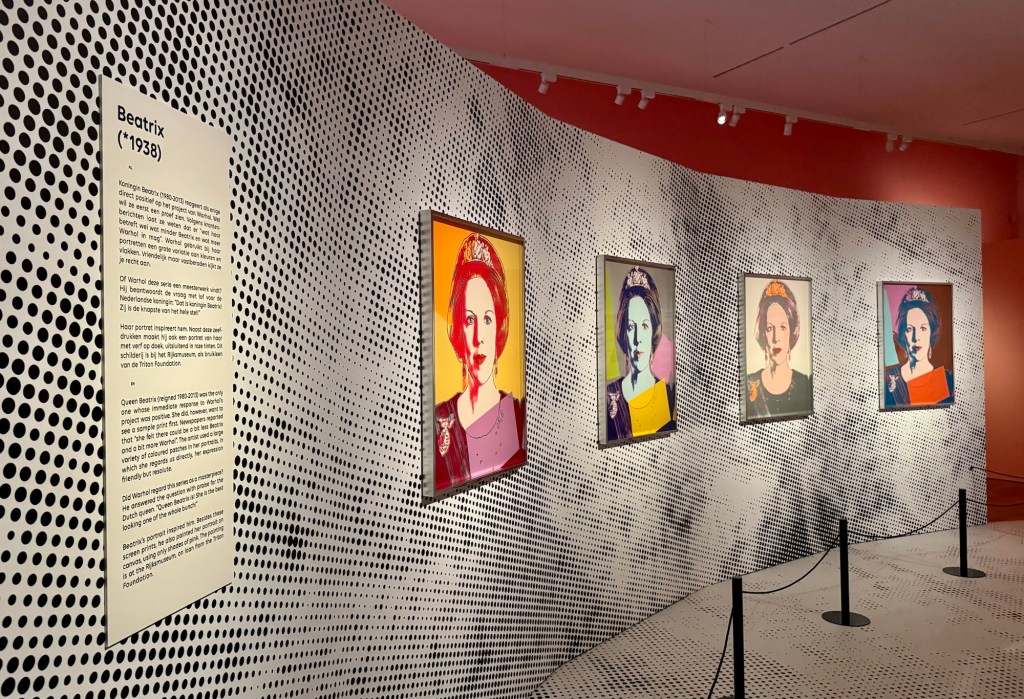
Below ground, however, I could feast my eyes on the small but enjoyable pop art exhibit Queens by Andy Warhol, as well as an exhibit in the Grand Foyer featuring a handful of weirdly fascinating sculptures created by artist duo Heringa/Van Kalsbeek.
And, shame on me for my lack of Dutch history knowledge, I finally learned why exactly the colour orange is our national colour of pride in the room dedicated to The House of Orange (it all stemmed from an inherited bit of land in France). I’ll carefully skate over the religious and political connotations, right onto how it has now become a colour of national sports pride (I always enjoy watching the annual sports overview -although, I muted the bit showing the 2024 UEFA EUROS, as it is still rather raw). Anyway, for a brief moment in time, the colour orange even featured on our national flag (orange-white-blue instead of the current red, white, blue)! Would have made more sense to keep it orange-white-blue, if you ask me.
A spiritual awakening?
Our second day brought us to the Kröller-Müller museum, which is located smack-bam in the middle of De Hoge Veluwe National Park. A beautiful location, great architecture, art everywhere, what else do you need for a perfect reflecting-sensemaking-outing to say good riddance to the year we’ve had?! Well, a bit of dry weather would have been nice. But no chance of that, so we decided to focus on the museum itself, and leave the 25 hectares (!!) worth of sculpture gardens for another day.
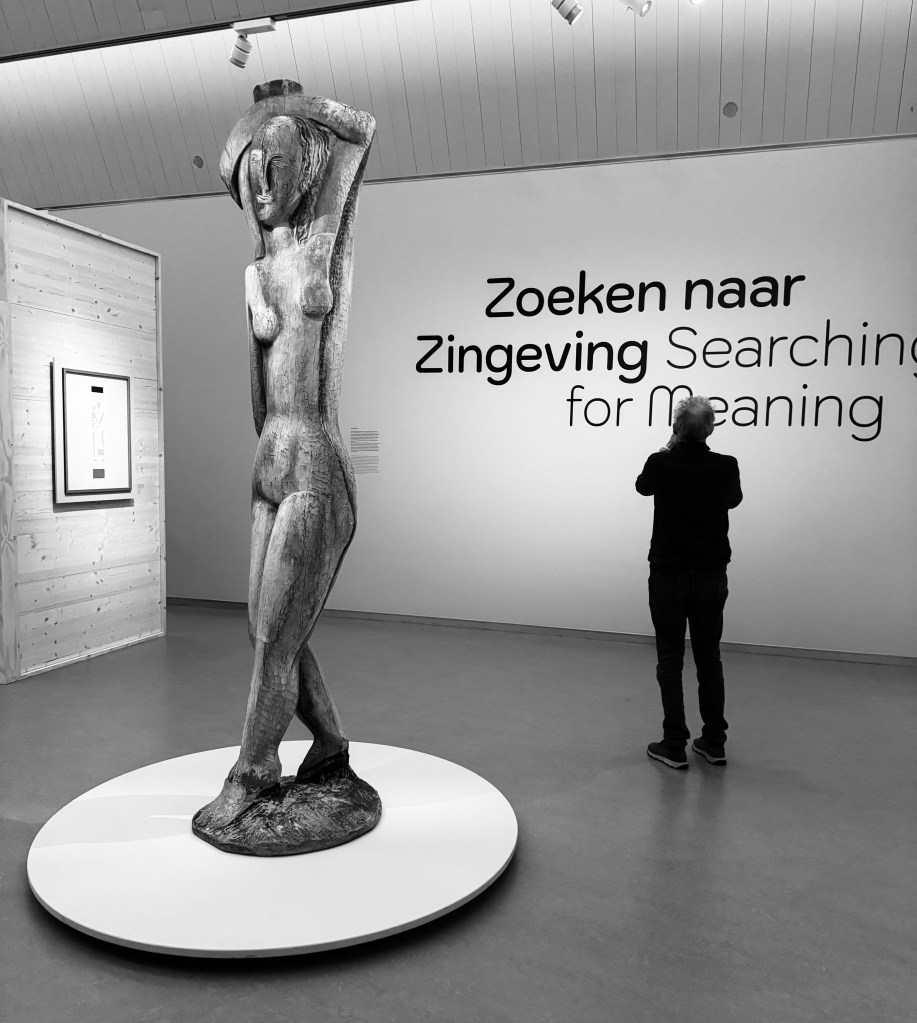
First stop was the exhibition Searching for Meaning, which is an exhibition, as it states on the website, ‘that inspires and invites contemporary philosophising about life and art’. To be completely honest, I felt a bit out of my depth walking through the rooms dedicated to this particular search for meaning. Perhaps it was a little above my spirituality paygrade, but I’m sure a more knowledgeable art connoisseur with a background in spirituality would have loved it! I can’t help mentioning another scare I had when confronted with The Lamentation of Christ (I know, the name says it all) by Jan Sluijters (1881-1957). This very large (180,5 x 250 cm) and very graphic painting invited me less to philosophise and more to walk right past it and propose to my fellow museum-goers that it was high time for a coffee break. If ever there was a case to be made for sensitivity warnings… (only joking; there’s still a little no-nonsense Dutch girl left in me).
Colourful dottiness
No, my particular philosophising and searching for meaning happened in a whole different section of the museum. Did you know that the Kröller-Müller houses the second largest collection of Van Goghs in the world? All of the other visitors did. As I followed the steady stream of Vincent fans to the Van Gogh wing, I decided to make a quick pitstop in one of the side rooms. Because from the corner of my eye I saw a few paintings that I’ve long-since held a fascination for, but which I’d never seen in real-life. These were paintings by Georges Seurat (1859-1891) in his famous pointillistic style. The fact that they are also very marketable and feature on many a mug, umbrella, and key chain by no means influences the fact that I find them to be very powerful ‘philosophisable’-searching-for-meaning works of art.
Rewind back to the other annual overview programmes I never skip watching at the end of the year: the ones showing the famous and not so famous people that passed away in the previous year. Pointillistic style paintings, particularly those by Seurat and fellow pointillist Paul Signac (1863-1935), besides being very pretty and colourful, always remind me of a comparison I once heard being said about losing a loved one. This person said that the loss of somebody close to you is just like missing a particular colour from your painting palette. And that colour will never return in the same hue.
In this context, I find Seurat and his contemporaries the ultimate hope-giving artists -all the while mixing and building up more colours and hues as best as possible. Never to fill the void that is left by the missing colour, but to add so many different layers and hues that then make up an altogether different painting. The most outrageous colour combinations can make up a single dot. And all gazillion dots together make up an image, the subject of which in itself is chosen by the artist. It’s a painting in a painting in a painting. Now, how’s that for philosophising, searching for meaning, and sensemaking?!
Goodbye 2024, hello 2025.
 Sensemaking.blog